
Terminal Services Manager questions, answered
Common questions on licensing, agentless setup, firewall ports, connecting with different credentials, shadowing permissions, and how it compares to tsadmin.
Before Installing
6 questionsThe Microsoft Remote Desktop Services Manager (the old tsadmin.msc) manages one server at a time, and Microsoft removed it from Windows Server after 2008 R2. Terminal Services Manager is an alternative that works on all current versions of Windows and manages many hosts together.
From a single window it shows the sessions, users, and processes of every server in your list at once, with live CPU, memory, disk, and network metrics. It keeps the familiar actions - disconnect, log off, shadow, send message, reset - and adds session history, failed logon auditing, filtering, and graphs. For the full story on where the old snap-in went, see where is Terminal Services Manager in Windows Server 2012 and later.
No. Terminal Services Manager is agentless. It connects to each Remote Desktop Services host using the Windows interfaces already built into the operating system: the WTS (Terminal Services) API for sessions, users, and processes; performance counters for CPU and memory; and the event log for session history. Nothing is installed or left running on the machines you manage.
You install the program only on your own workstation or a management server. The hosts you manage need to be reachable over the network, and you need administrator rights on them. To get started, see How to add your RDS servers and connect with the right account and System requirements.
The latest version of Terminal Services Manager supports the following Windows platforms: Windows 10, Windows Server 2016, Windows Server 2019, Windows Server 2022, Windows 11, Windows Server 2025.
It runs on any Windows version that ships Remote Desktop Services and the supporting WMI and RPC interfaces, on both workstations and servers. For the full list and the rights you need, see System requirements.
Terminal Services Manager has light requirements and runs on both Windows workstations and servers:
- Any Windows version with Remote Desktop Services and its WMI and RPC interfaces
- Administrator rights on the machine where it runs (see administrative privileges)
- A network connection to the Remote Desktop Services hosts you manage
- Internet access to register the program and receive updates
For the complete list, see System requirements in the handbook.
No. Installing Terminal Services Manager requires administrator rights. If you will use it only on the local computer, local administrator rights are enough. To manage Remote Desktop Services hosts across your network, run it under a domain account that has administrator rights on those hosts.
This is also why the program asks for elevation each time it starts. See System requirements for details.
You can download Terminal Services Manager from our Download page. The installer is a standard Windows setup; run it and follow the prompts.
If you manage machines with winget, you can also install it from the Microsoft winget repository. See Installing Terminal Services Manager for both methods, and System requirements for what you need first.
Registration
5 questionsYes, for personal use. The Personal License is free and perpetual, for non-commercial use only.
Using it at work needs a paid license. A Business License covers one machine and includes a year of updates. A Corporate License covers a whole organization, with unlimited installations and technicians. Prices are on the purchase page.
If you want to try it first, the evaluation copy has no feature limits: every feature, on one computer, with a reminder at startup.
There are no feature limitations in an unregistered copy. During the evaluation period you can use every feature of Terminal Services Manager on a single computer, exactly as in a registered copy. Unregistered copies show a reminder screen at startup, and use is limited to one machine on the network.
To remove the reminder and run the program on more machines, register your license. See also how to order and using it on more than one computer.
The quickest way to buy Terminal Services Manager is to order online and download it right away. Pick a payment option on the purchase page and complete the order.
After your purchase you receive an email with a registration number. Use it to activate your copy, as described in Registering your license.
Each installation on a separate machine needs its own license. If you plan to run Terminal Services Manager on several computers, order the matching number of licenses on the purchase page.
To activate a license once you have it, see Registering your license.
If you have lost your registration number, you can request a copy. Fill out the registration information request form with the email address used for the purchase, and we will resend your license details.
Once you have the number again, follow Registering your license to activate the program.
Troubleshooting
8 questionsTerminal Services Manager uses standard Windows management protocols, so the same ports you would open for any remote administration are enough. On each managed host, allow access from your workstation to:
- TCP 445 (SMB) - session, user, and process lists through the Terminal Services (WTS) API, and performance counters
- TCP 135 and the dynamic RPC range - performance counters and the event log used for session history and failed logons
- TCP 3389 (RDP) - only if you connect to or shadow a session
- ICMP and TCP 135 - the checks that tell whether a host is up
On a domain network the built-in Remote Administration and Windows Management Instrumentation (WMI) firewall rule groups already open these. To get hosts into the program in the first place, see How to add your RDS servers and connect with the right account.
Terminal Services Manager reads most data through the WTS API, but it uses Windows performance counters (Perfmon) for CPU usage and Available memory. If those two columns are empty or stuck while the rest of the data updates normally, the performance counters on the monitored server are the usual cause.
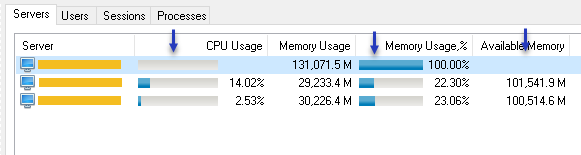
To repair the counters, see Troubleshooting monitoring issues for performance counters. For what each column means, see the server metrics reference.
Symptoms
When you use Terminal Services Manager to read RDP incoming or outgoing bytes for a Remote Desktop session on Windows 8.1, Windows Server 2012 R2, Windows 8, or Windows Server 2012, the value is always zero.
Cause
This is a known Windows issue in the session networking counters, not in Terminal Services Manager.
Resolution
Install the Microsoft hotfix from Knowledge Base article 2981330 on the affected server, then restart it. The byte counters appear in the user session metrics.
Terminal Services Manager uses the Windows remote control (shadow) feature through mstsc, so the client and the target host must use the same shadowing protocol.
Windows Server 2012 R2 (and Windows 8.1 through Windows 11) use a different shadowing protocol than Windows Server 2008 / 2008 R2 (Windows 7). You cannot shadow a session on a 2012 R2 or newer host from a 2008-era client, or the other way around. The message "The version of Windows running on this server does not support user shadowing" means the two ends use incompatible versions.
To shadow a session on a Windows Server 2008 / 2008 R2 host, run Terminal Services Manager from a session on that same host and use the Shadow command there.
For how shadowing works, see Shadowing a user. If it fails with a consent or group policy message instead, see the user consent error.
This shadowing failure was caused by the January 2018 Meltdown and Spectre update (KB4056890) on Windows Server 2016 and 2012 R2. Microsoft fixed it in a later update, so installing the latest cumulative update on the server resolves it.
Windows Server 2016 - January 17, 2018, KB4057142 (OS Build 14393.2034): support.microsoft.com/help/4057142. It addresses the issue from KB4056890 where calling CoInitializeSecurity with the authentication level set to RPC_C_AUTHN_LEVEL_NONE returned STATUS_BAD_IMPERSONATION_LEVEL.
Windows Server 2012 R2 - January 17, 2018, KB4057401 (Preview of Monthly Rollup): support.microsoft.com/help/4057401.
After updating, test shadowing again. See Shadowing a user, and the version mismatch error for client and host protocol differences.
This message means a group policy requires the user's consent before a session can be shadowed. You have two options:
- Change the policy so consent is not required, following Microsoft Knowledge Base article 292190.
- Leave the policy as is and select the Prompt for user consent option in the Shadow window, so the user is asked to approve.
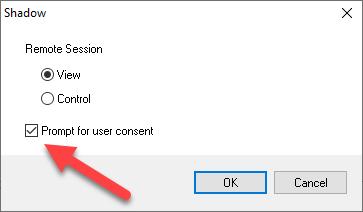
For the full shadowing workflow and its options, see Shadowing a user.
By default only administrators can shadow (remotely view or control) a Remote Desktop session. To let a non-administrator do it, grant the remote control right on the RDS host instead of giving full admin rights.
You set this with a Group Policy option and a one-line WMI command that gives a specific user or group shadow permission on the session host. The full procedure, with the exact policy path and command, is in How to grant shadow access rights for users without granting full admin rights on RDS servers.
For how shadowing works in the program once the rights are in place, see Shadowing a user.
This almost always means the program was not registered with administrator rights, so it could not save the license.
Register with administrator rights
Right-click the program shortcut, choose Run as administrator, then enter your registration information again.
If it still asks every time
Download and install the latest version of Terminal Services Manager, then register from the command line:
tsmanager.exe QUIETREGISTER LICENSED_TO,LICENSE_KEY
Replace LICENSED_TO with the registered name and LICENSE_KEY with the key from your registration email. For the usual way to register, see Registering your license.
Miscellaneous
7 questionsDisconnect drops the connection and leaves the apps running. Log off ends the session cleanly and returns its memory and license. Reset forcibly kills a session that will not log off, and unsaved work is lost.
From the command line, find the session with query session, then run tsdiscon, logoff, or reset session with the session ID.
In Terminal Services Manager you right-click a user, or select many across different servers and act on them together. The Servers tab also has a one-click action to log off every disconnected user.
Full command reference: How to disconnect, log off, or reset a Remote Desktop (RDS) user session.
Add the account to the local Remote Desktop Users group on the session host. Then check that the Allow log on through Remote Desktop Services right includes that group, because a policy can override the group membership.
Across a domain, use Group Policy for the right and Add-LocalGroupMember or a restricted group for the membership.
The step-by-step version, with the exact policy path and the PowerShell, is in How to add users and grant RDP permissions on Windows Server. Once people are connecting, Terminal Services Manager shows their sessions on every host in one window.
Yes. The import file is a plain text file with one computer name or IP address per line. Terminal Services Manager reads each line and adds it to the computer list.
For the full import and export workflow, see Importing and exporting the computer list. To build a list automatically from your network, Active Directory, an IP range, or other sources, see Adding computers using the wizard.
Terminal Services Manager connects to every host in the list under the single Windows account it is running as. It does not store a separate user name and password per computer or per group. To use a different account - for example a domain administrator, or an account in another domain - start the program with that account using Windows Run as different user:
runas /user:DOMAIN\rds-admin "C:\Program Files\LizardSystems\Terminal Services Manager\tsmanager.exe"
Every session, process, and power action then runs as that account against all the servers in your list. See Connection credentials for details, and How to add your RDS servers and connect with the right account for the setup.
Yes. On the Servers tab, select one or more servers (hold Ctrl or Shift to pick several), right-click, and choose Send message to all users. The message appears as a box on every user's desktop across all the selected servers, so you can warn a whole farm before maintenance in one step. To message one person instead, select their row on the User sessions tab and choose Send message.
You can save standard wording as message presets, including variables such as the computer name and current time that the program fills in when the message is sent. For the full walkthrough, see How to send a message to all Remote Desktop users and Sending a message.
Yes. Terminal Services Manager can reconstruct logon, logoff, disconnect, and reconnect events for a server from its event logs. Use the Session history dialog for a per-server or per-user timeline, and Users activities to browse the raw Terminal Services session events.
For long-term reporting and auditing across many servers, our dedicated tool Remote Desktop Audit collects and analyzes this data over time.
Neither is wrong; they measure over different intervals. CPU usage is an average, and the value depends on the length of the sampling window, so two tools that sample at different rates report different numbers for the same process. The chart below shows how the same activity looks different depending on the measurement period.
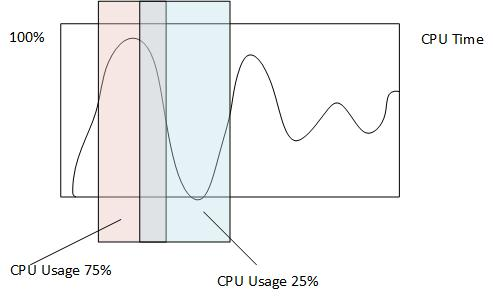
For how Terminal Services Manager reports CPU and the other process counters, see the process metrics reference.